

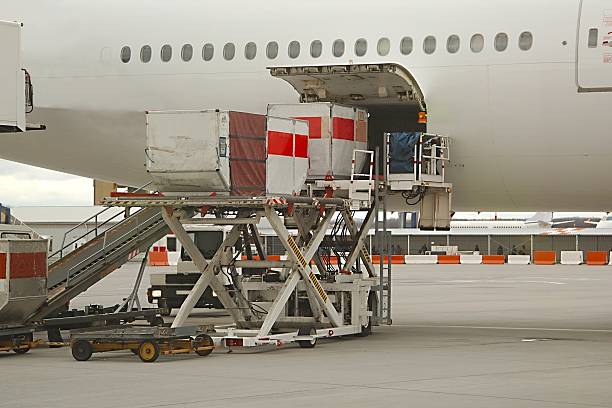
In air freight, optimizing space and ensuring cargo safety are critical factors. One of the most important tools that airlines rely on to manage cargo efficiently is the ULD – Unit Load Device, a standardized equipment used to contain, consolidate, and secure cargo on aircraft.
In this article, Elite Shipping Vietnam will explain what ULDs are, how they are classified, the most common ULD types, and the roles, processes, and important notes when handling ULD cargo.
1. What Is a ULD?
* A ULD (Unit Load Device) is a standardized piece of equipment used to:
Consolidate cargo and baggage
Secure goods on the aircraft
Optimize aircraft cargo hold space
Speed up handling processes at airports
* ULDs are divided into two main groups:
Container-type ULDs (with shell) – e.g., AKE, AKN, AMP
Pallet-type ULDs (flat base) – e.g., PMC, PAG, PLA
2. Why Are ULDs Important in Air Freight?
2.1. Optimal use of aircraft space
ULDs help airlines maximize cargo hold capacity and avoid wasted space.
2.2. Improved cargo safety
Cargo is secured tightly, minimizing movement during turbulence.
2.3. Faster handling time
Instead of loading cargo piece by piece, ground handlers can load a whole ULD at once.
2.4. Easier management & reduced loss
Each ULD has a unique ID, allowing accurate tracking throughout the flight journey.
3. Understanding ULD Codes – How to Read Booking & Load Plans
A ULD code typically looks like: XYZ 12345 AB
XYZ: ULD type (AKE, PMC, PAG, etc.)
12345: Serial number
AB: Owner code (e.g., AA -American Airlines, KE – Korean Air)
Example:
AKE12345 KE = AKE container number 12345 owned by Korean Air.
4. The Most Common ULD Types in Use Today:
A. CONTAINER-TYPE ULDs
A-1. AKE (LD3) – The Most Common Container
Shape: curved top
Volume: ~1.5 m³
Max load: 1,588 kg
Suitable for: lightweight cargo, baggage, e-commerce, express shipments
Used on: A330, B777, B787, etc.
Key feature: Compact and easy to load, ideal for small or loose cargo.
A-2. AKH / AKN – Multi-purpose Containers
Used for baggage and light goods
Similar dimensions to AKE but with different load limits
Part of the LD3 family with improvements in door design or material
A-3. AMP / AMF – Large Containers
Used for bulky cargo, long pieces, or small pallets
Ideal for long-haul international flights
Common on wide-body aircraft
B. PALLET-TYPE ULDs
B-1. PMC (P6 Pallet) – Most Widely Used
Size: 96 x 125 inches
Max load: 6,800 kg
Suitable for heavy, bulky shipments or cargo requiring netting
Common on freighters (B747F, B777F)
It has no shell, just a flat base with a cargo net.
B-2. PAG – Standard Pallet
Similar to PMC but with slight differences along the pallet edge
Widely used in general air cargo export
B-3. PLA / PMA – Oversized Pallets
Designed for oversized cargo
Require multiple tie-down points for safe securing
5. How Airlines Choose the Right ULD for Your Cargo
* Airlines decide based on:
Cargo weight and volume
Cargo type (loose, palletized, long-length items)
Aircraft type (wide-body vs. narrow-body)
Availability of ULDs at the departure airport
Load plan for the specific flight
* Examples:
E-commerce cargo → AKE
Heavy machinery → PMC / PAG
Cargo longer than 2m → AMP / AMF or pallet
6. Important Notes When Loading Cargo Into a ULD
✔ Check ULD condition (torn nets, dents, deformation)
Damaged ULDs can be rejected by airlines.
✔ Prevent cargo from shifting
Especially for pallets-use straps or nets to secure the load.
✔ Apply full labeling: MAWB / HAWB; Piece count; Routing labels; Special cargo labels: PER, DGR, VAL, etc.
✔ Do not stack heavy items over light items
This prevents crushing or deformation.
✔ Ensure weight balance within the ULD
Airlines require proper distribution from left–right and front–back.
7. Real-World Scenario: “Your cargo is spread across 1 ULD and 2 AKEs”
This means:
The shipment was not consolidated into a single ULD. It is split across one pallet/container plus two small containers → This makes tracking difficult and may affect transit handling or delivery. You may request the airline to “Request consolidate cargo into a single ULD if possible.”
8. Conclusion
ULDs play a crucial role in:
Cargo handling efficiency
Cargo safety
Transportation costs
Logistics service quality
Understanding ULD types helps logistics professionals- especially at Elite Shipping Vietnam– reduce risks, optimize costs, and work more effectively with airlines, GHAs, and customers.